LuxLibre
EDCO v0.2
On this page: What changed from v0.1 · Specifications · Light and runtime · How it is built · Electronics · Cost · Drawings and animations · What has been checked · Open points before the first order · Files
EDCO v0.2 makes the EDCO light brighter and gives it a more rugged look, in two sizes:
| EDCO-18 | EDCO-14 | |
|---|---|---|
| Cell | one 18500 | one 14500 |
| Body / head | Ø24 / Ø26 mm | Ø20 / Ø22 mm |
| Length | 97.8 mm | 95.6 mm |
Both run a Luminus SST-40 LED behind a TIR optic. Charging, firmware updates and settings all go through a USB-C port on the side of the head, under a fluted twist collar. There is still no laser and no radio.
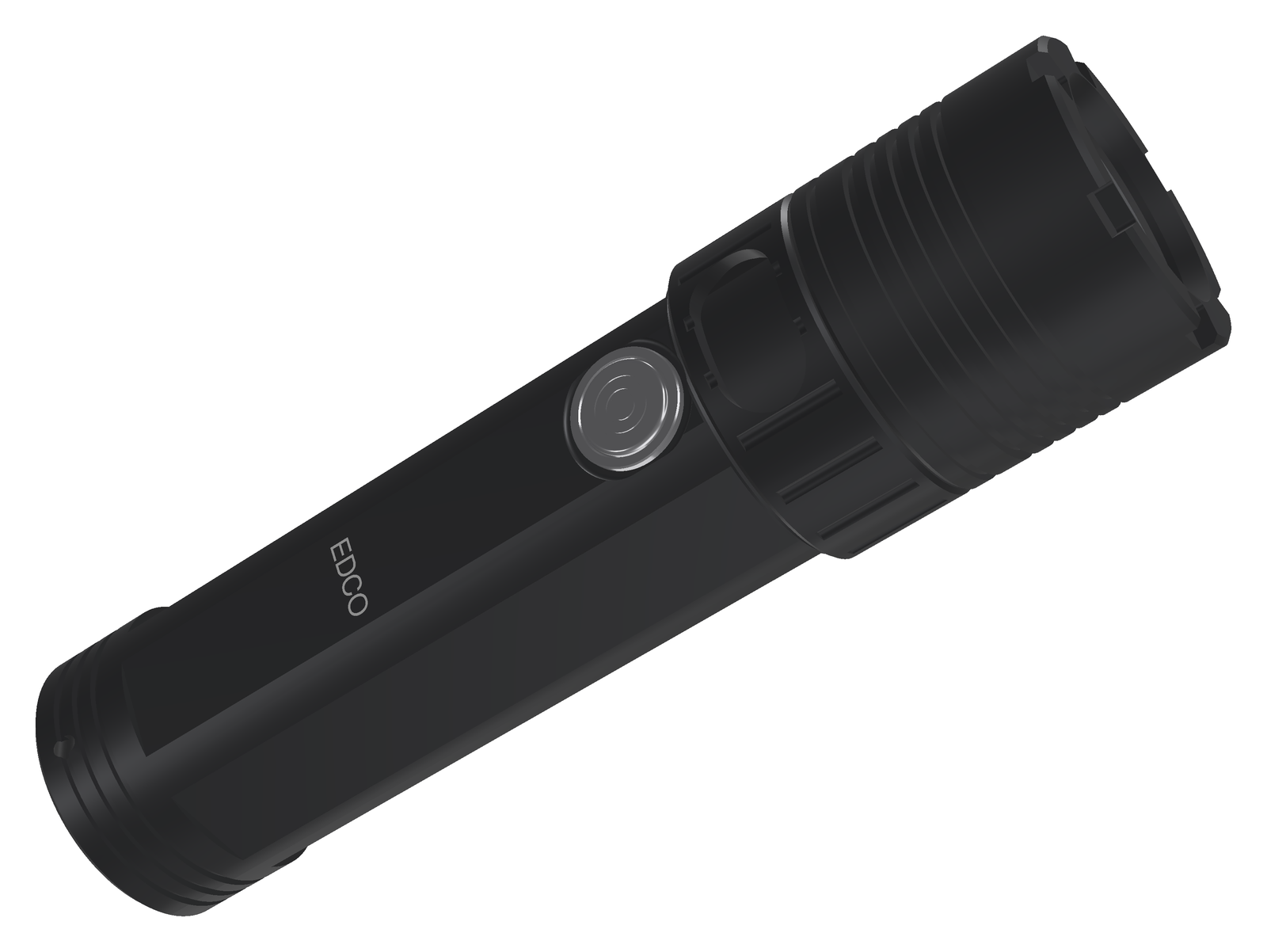
Render made from the design files.
Status: concept (v0.2). The housing of both sizes is modelled in CadQuery and checked for fits, walls and interference. The firmware board headers exist, and the light output is simulated with the LuxLibre simulator. The circuit boards are not drawn yet, and nothing has been built or measured. Every light figure on this page is simulated.
What changed from v0.1
The owner asked for these changes:
- About 2000 lm. The SST-40 replaces the SST-20. Driving it near 6 A needs a cell that can deliver the current, so EDCO now comes in two sizes: the 18500 version gives full output, and the 14500 version keeps the slim body.
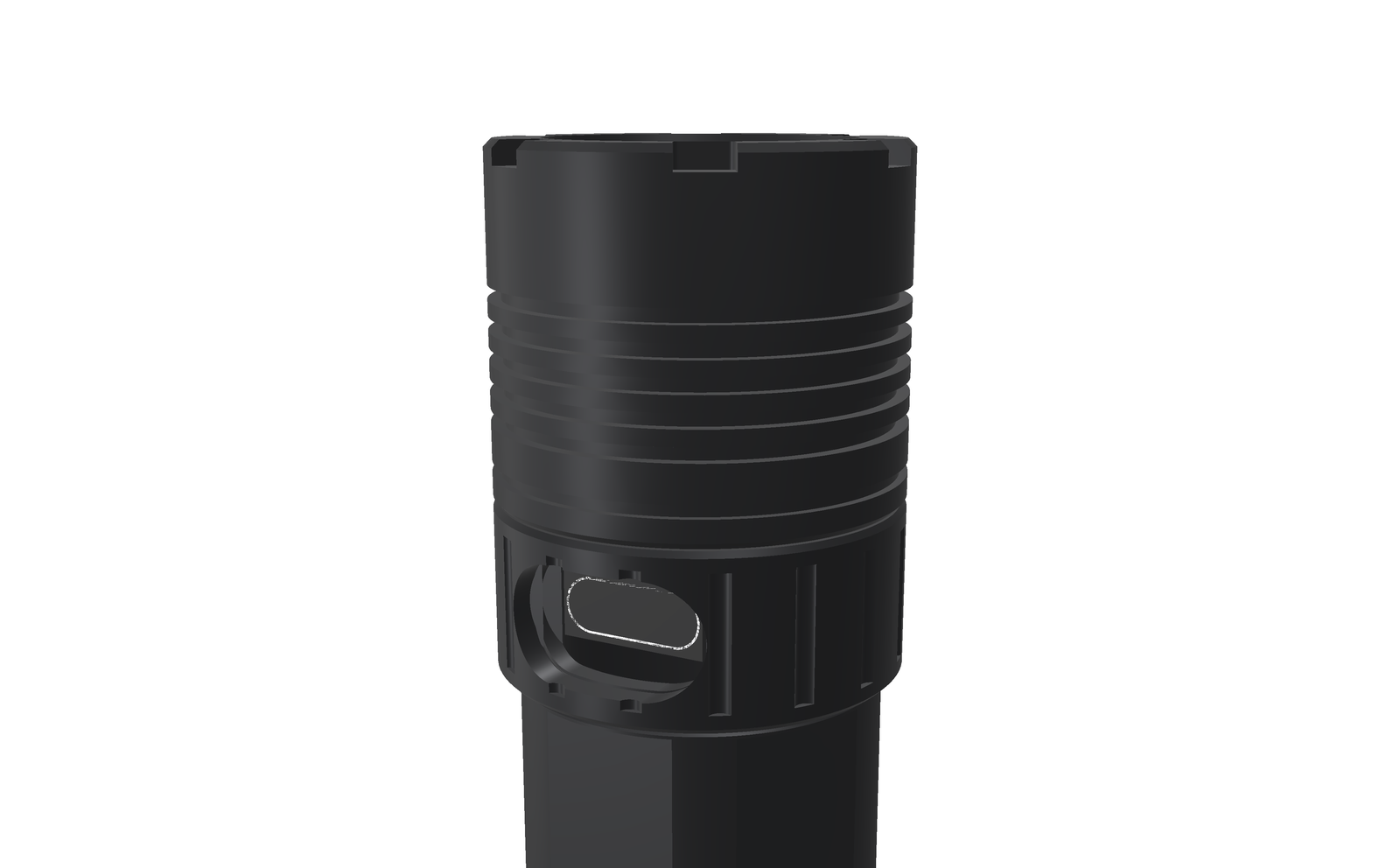
- USB-C on the side. The socket now sits on the main board and looks down through a window in the side of the head. The collar turns over that window: with the collar’s window over the port, the port is open; turned away, the port is covered and sealed.
- A more tactile look:
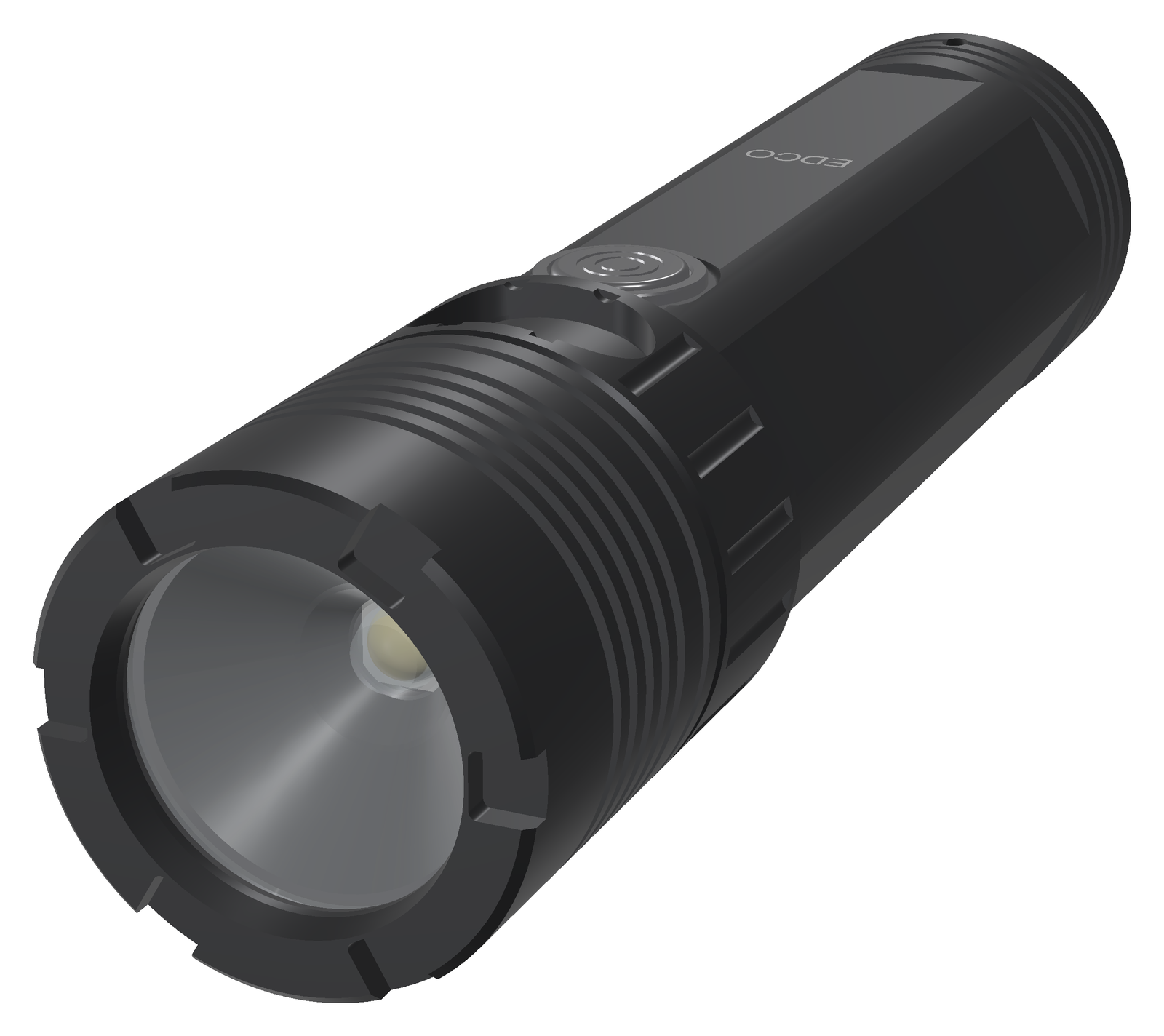
- a crenellated bezel with five cooling fins;
- a fluted collar;
- six milled flats along the body;
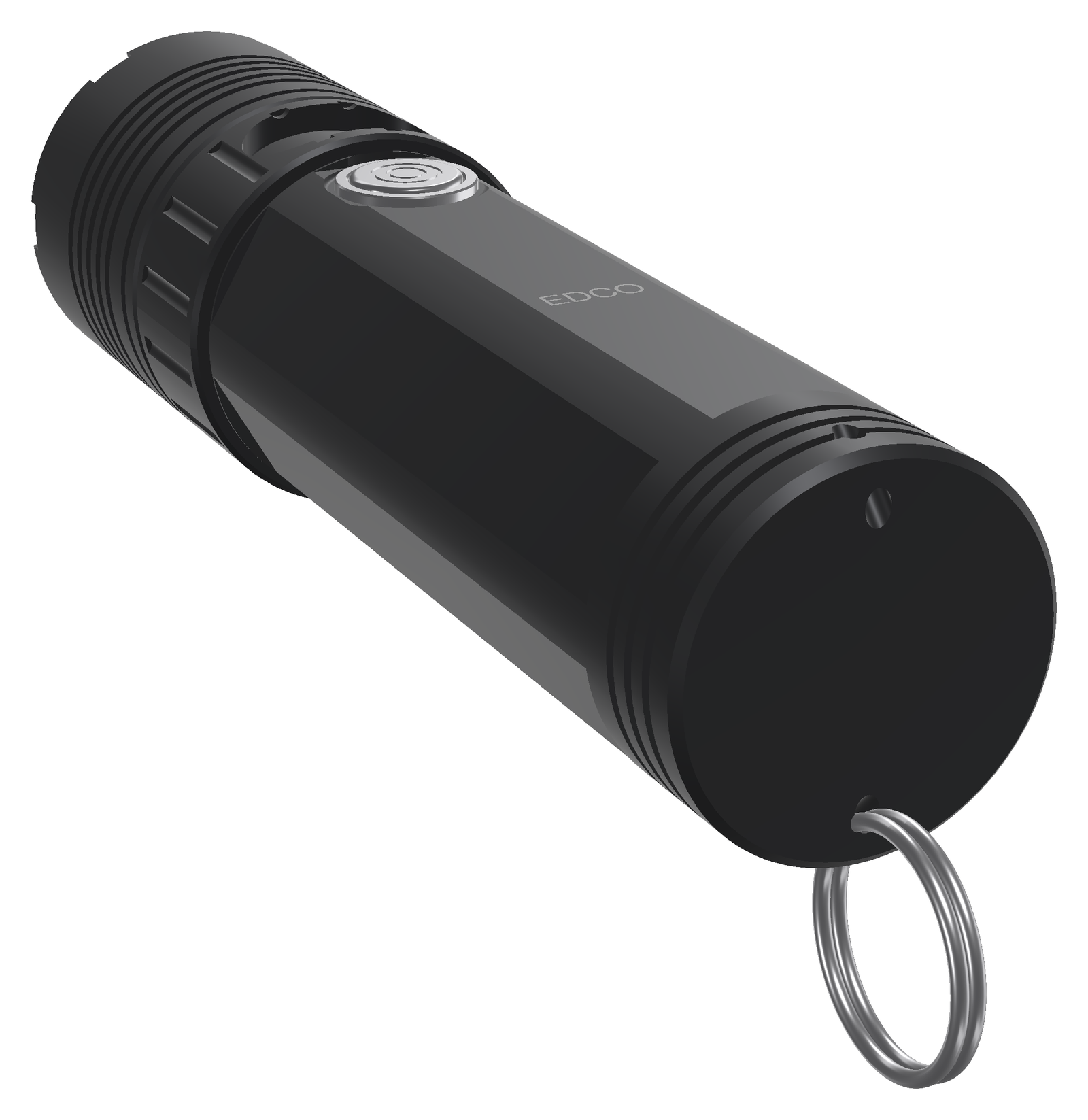
- three grooves at the tail.
- A bigger button. The stainless cap grows from Ø4.2 to Ø7.5 mm (EDCO-18) or Ø6.5 mm (EDCO-14). Its translucent membrane glows when lit, so the separate indicator dot is gone.
 |
 |
|---|---|
| Front. Crenellated bezel, fins, the TIR optic. | Port open. The collar’s window over the USB-C socket. |
 |
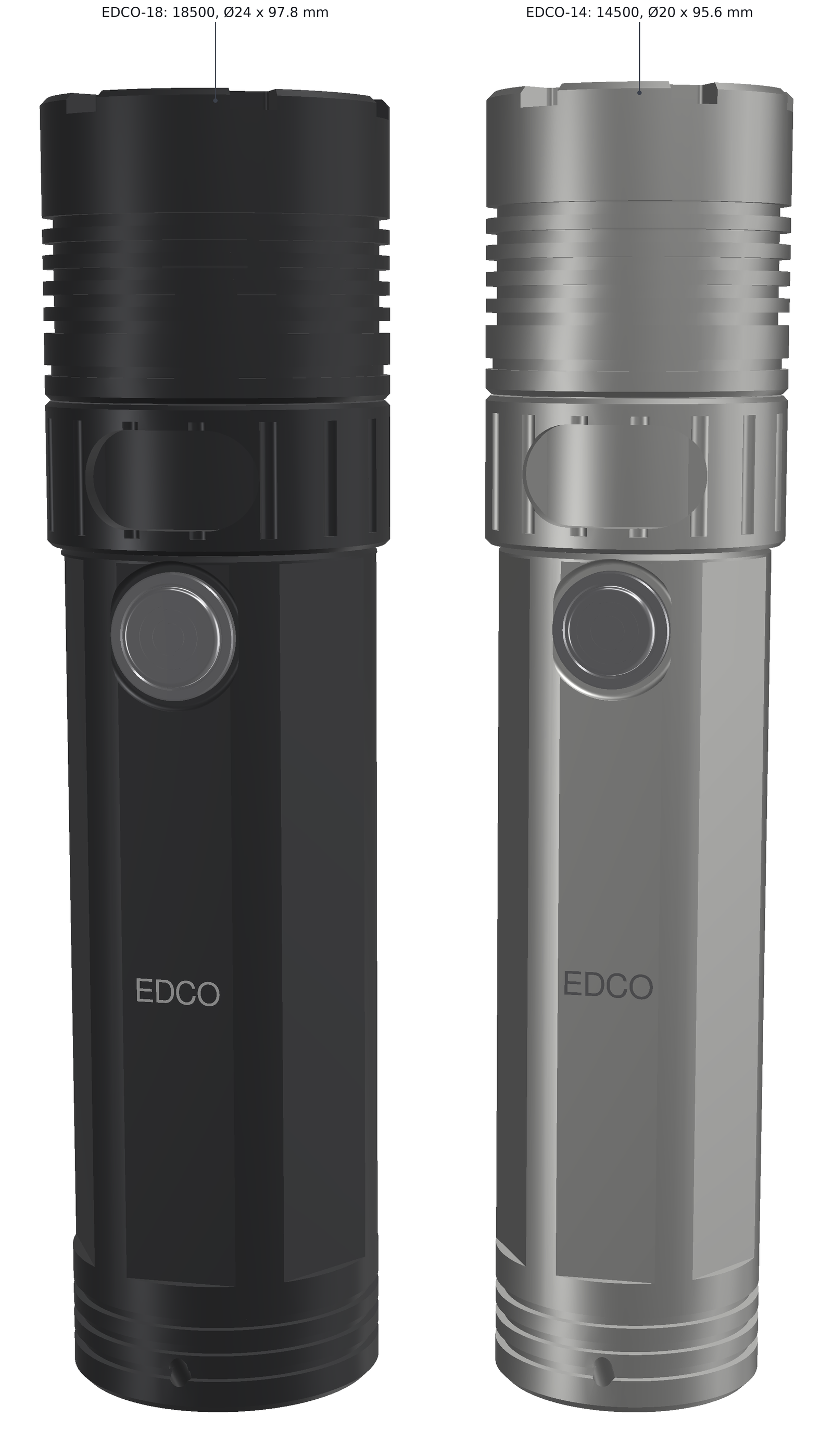 |
| Tail. Grooves, flats and the two lanyard holes. | Two sizes. EDCO-18 (black) and EDCO-14 (clear anodised). |
Specifications
| Item | EDCO-18 | EDCO-14 |
|---|---|---|
| Size | Ø24 body, Ø26 head × 97.8 mm | Ø20 body, Ø22 head × 95.6 mm |
| Aluminium parts (body, bezel, head insert, collar; from the CAD) | 45.1 g | 36.2 g |
| LED | Luminus SST-40-W Gen 2, 6500 K, on a 20 mm copper DTP board | the same on a 16 mm board |
| Optic | Carclo 10003 narrow spot TIR, Ø20 mm (87 %, about 17° with a 5 × 5 mm LED) | LEDiL FA10888 TINA-RS, Ø16.1 × 10.9 mm (14–17°; fit over the SST-40 dome to be checked) |
| Turbo (simulated) | 5,700 mA: 2,022 lm at the LED and 1,759 lm out of the front with the LED at 85 °C. About 8 % more in the first seconds with a cool LED (about 1,900 lm out of the front) | 5,000 mA: 1,836 lm at the LED, 1,561 lm out of the front |
| Throw (estimate) | about 18 kcd, 270 m (Carclo’s 9.1 cd/lm with an XM-L2) | about 11 kcd, 210 m (scaled by aperture; no data published) |
| Cell | Vapcell INR18500 K15: 1,500 mAh typical, 15 A, 18.2 × 50.0 mm | Vapcell INR14500 H10: 1,000 mAh typical, 10 A, 14.3 × 49.4 mm |
| Runtime from turbo to the ANSI end point (simulated) | 99 min | 78 min |
| Driver | MPS MP2145GD 6 A synchronous buck with 100 % duty mode, in the LuxLibre current loop (TLV333, 10 mΩ sense) | the same |
| Cell protection | DW01A with a common-drain MOSFET path of about 15 mΩ: trips at about 9.3–12 A | the same |
| USB-C | SHOU HAN TYPE-C 16PLT-H6.5 (LCSC C3151748), vertical, 6.5 mm, on the underside of the main board | the same |
| Charging | TP4057 at about 500 mA (about 3 h) | about 2 h |
| Button | Ø7.5 mm stainless cap, glowing membrane, Alps SKRKAEE020 | Ø6.5 mm cap |
| Water | IPX8 is the target, not tested. Seals: the optic gasket, the face O-ring of the head insert, the button membrane, and the cord gasket round the port (sealed whenever the collar is turned away) | the same |
| Firmware | LuxLibre, board edco-v02-18 |
board edco-v02-14 |
Light and runtime (simulated)
These are LuxLibre simulator runs with each size’s board header: 25 °C still air, a full cell and the default profile. Lumens are out of the front, with the LED at 85 °C.
| EDCO-18 | EDCO-14 | |
|---|---|---|
| Turbo | 1,759 lm, full for 45 s (the turbo timer); 48 s with the timer off | 1,561 lm, full for 44 s |
| High (1.8 A) | 686 lm for 281 s | 662 lm for 212 s |
Sustained (temperature regulator, THM_LIMIT 49 °C) |
about 330–390 lm, body at most 47.5 °C | about 260–320 lm, body at most 47.7 °C |
| Turbo from a half-full cell, at 30 s | 1,543 lm | 1,463 lm |
| On a 35 °C day | full turbo for 23 s, about 200 lm sustained, body 48.4 °C | 21 s, about 150–200 lm, body 48.6 °C |
| Runtime from turbo to the ANSI end point | 99 min | 78 min |
| Modes (out of the front) | moon 3 mA (1 lm), low 27 lm, medium 155 lm, high 686 lm | moon 3 mA (1 lm), low 26 lm, medium 149 lm, high 662 lm |
- Burst length. The SST-40 at 5.7 A turns about 14 W into heat. Even the 18500 body therefore holds full turbo for under a minute, as with any light of this size.
- What the bigger cell buys. The 18500 brings mainly current and a bigger heat sink, not much more charge. The K15 holds 1,500 mAh, like the v0.1 14500. A 2,000 mAh 10 A 18500 (Vapcell N20) may exist but was not verified.
cd firmware
make sim BOARD=edco-v02-18
build/luxsim-edco-v02-18 --preset board --set TURBO_S=0 "2C W900000"
make sim BOARD=edco-v02-14
build/luxsim-edco-v02-14 --preset board "2C W14000000"
How it is built
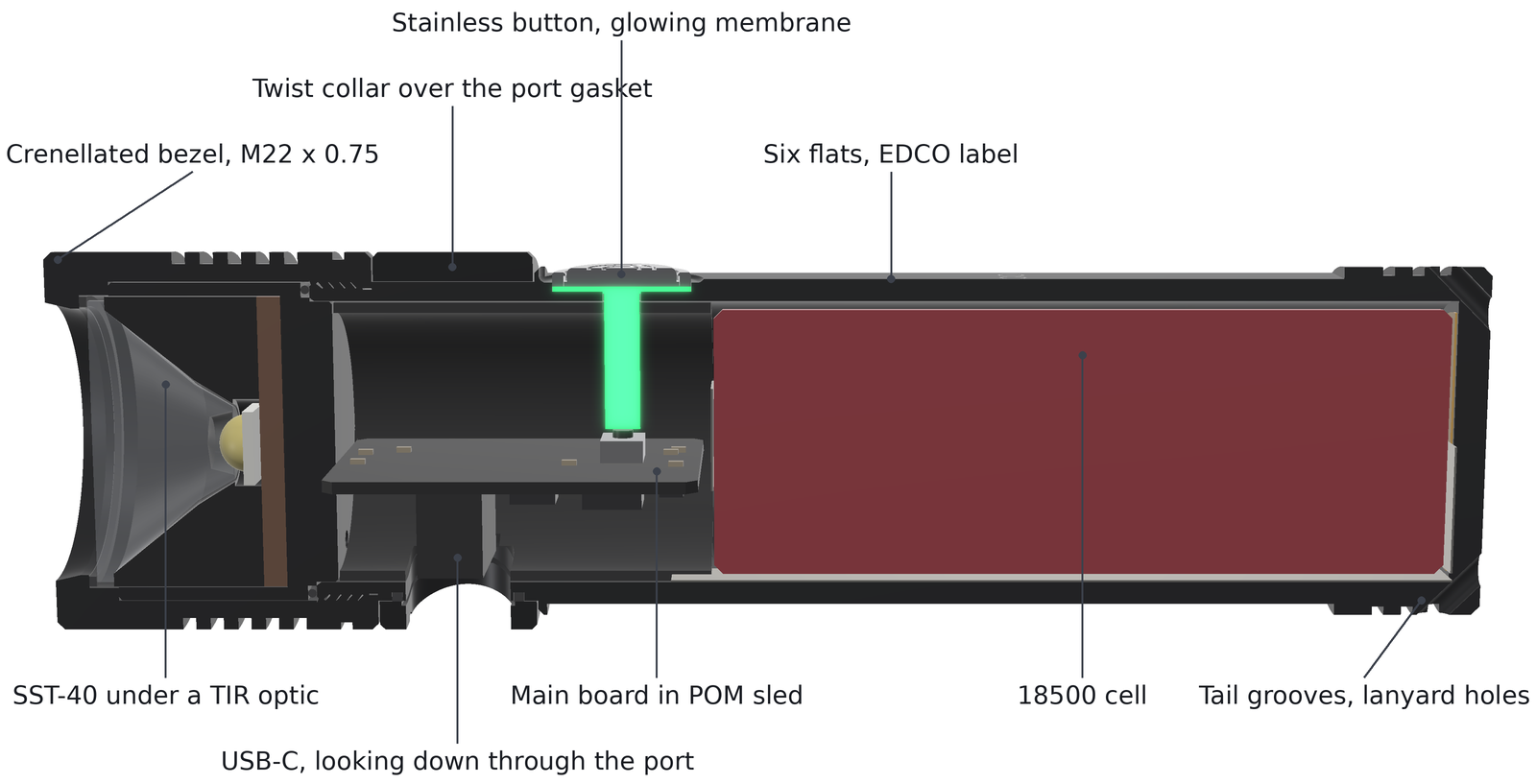
From the front to the tail:
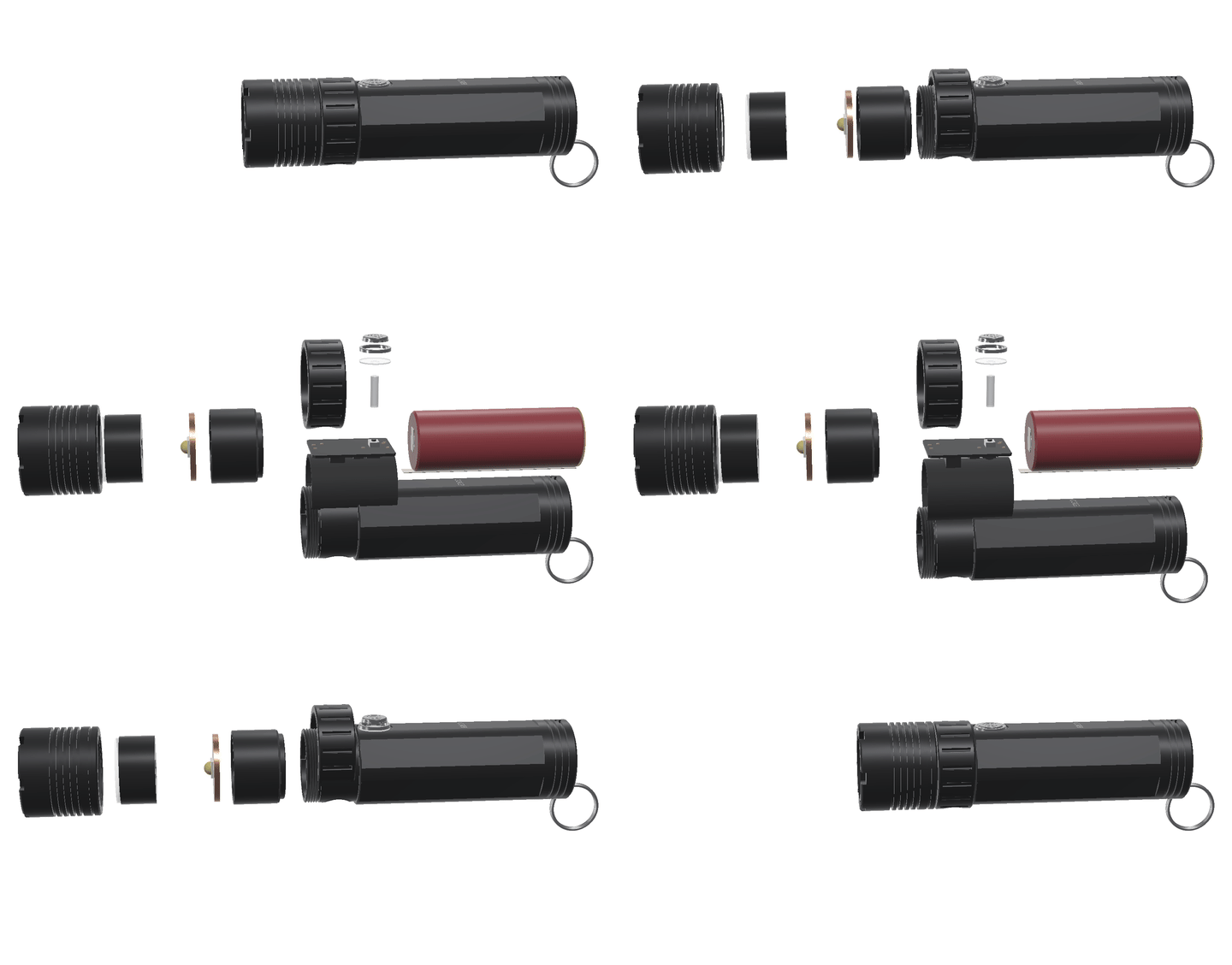
- Bezel. It is crenellated and has five cooling fins. It screws onto the band’s external thread (M22 × 0.75 on EDCO-18, M18 × 0.75 on EDCO-14) and is locked with thread-locker. Its lip presses the optic onto a silicone gasket, and its inner shoulder clamps the head insert, metal on metal, against the band’s front face.
- Head insert. The LED holder. It has a cup for the optic and carries the SST-40 on its copper board, on a 2 mm floor that leads the heat into the body. A face O-ring on its rear face seals against the band. A key in a notch stops it turning while the bezel is tightened, so the LED wires never twist.
- Twist collar. It turns freely between the bezel and the body shoulder.
- The seal: a loop of Ø0.8 mm silicone cord, bonded into a 0.75 mm groove round the port window in the band. The collar’s bore presses and wipes it, so the port is sealed whenever the collar’s window is turned away.
- Why it is built this way: the space between the collar and the band may get wet. Only the port window leads into the light, so one gasket round it is enough, with no O-rings needed on either side.
- Main board in a POM sled. The board lies across the bore.
- The vertical USB-C socket on its underside looks down through the port window. The sled backs the board, so it takes the force of a plug.
- The tactile switch on its top side sits under the button’s clear pin.
- An RGB LED next to the switch lights the pin and the translucent membrane: the halo indicator.
- Cell. Its + strip goes to the rear of the main board. The − strip runs forward along the bottom of the cell.
- Tail. A closed end with three grooves and a lanyard hole through each corner. v0.2 has no tail board and no flex.
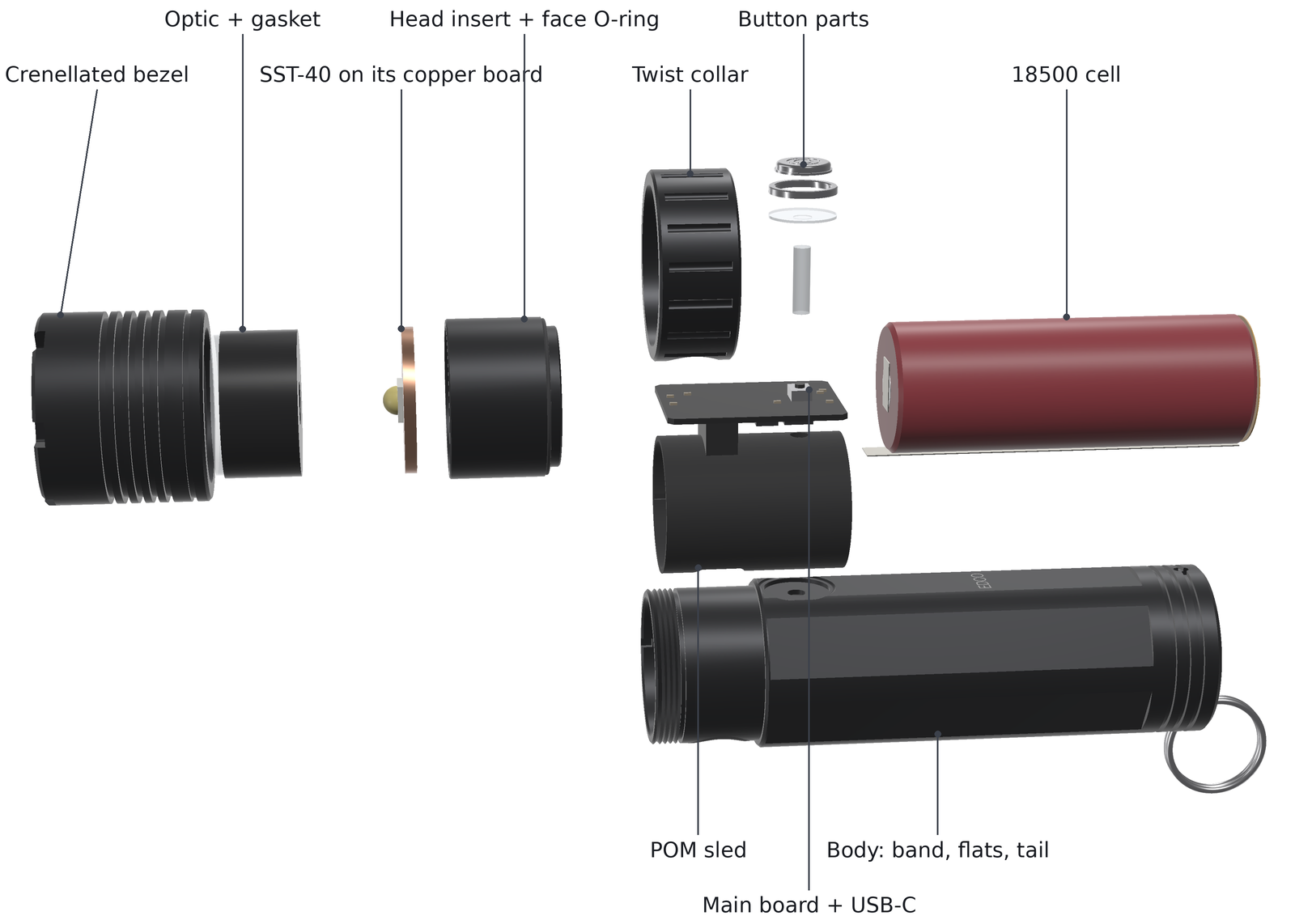
Assembly (once, for good)
- Bench-test the cartridge.
- Weld the strips to the cell. Solder the cell and the LED wires to the main board.
- Test the cartridge on the bench and flash the firmware over USB-C.
- Insert the cartridge.
- Slide the cartridge into the tube with the socket facing the port window. The window shows when it is lined up.
- Drop in the clear pin, the membrane, the cap and the button collar (press-fit with retaining compound).
- Fit the head.
- Bond the cord gasket into the band groove and grease it lightly with silicone grease.
- Slide the collar on from the front.
- Fit the head insert with its face O-ring, the LED board on paste, the optic and its gasket.
- Screw on the bezel with medium-strength thread-locker.
Electronics: what changes from v0.1
| v0.1 | v0.2 |
|---|---|
| TPS62095 4 A buck, 20 mΩ sense, VSET 2.2 k / 100 k | MP2145GD 6 A buck (QFN-12 2 × 3 mm, high-side limit 7.5–8.1 A, FB 0.6 V) with an inductor of about 0.47–1 µH (Isat ≥ 9 A, 4 × 4 mm) and a 10 mΩ sense resistor. VSET 1.0 k / 53.6 k: 6,044 mA at full duty; the firmware never asks for more than 5,700 mA. Backup: TI TPS62480 (2 × 3 A phases). TI’s TPS62866/9 do not fit: their output is set over I²C and stops at 3.35 V |
| DW01A + SE8830A (trip about 5.4 A) | DW01A with a common-drain path of about 15 mΩ, for example AOS AOC4810, or two TI CSD17575Q3 (LCSC C529277) plus a 10 mΩ resistor. Trip about 9.3–12 A; about 0.5 W in the path at 6 A |
| Waterproof socket on a tail board, 4-wire flex | vertical SHOU HAN TYPE-C 16PLT-H6.5 (C3151748) on the main board; CC resistors and ESD on the main board; no tail board, no flex |
| Indicator LED and light pipe | RGB LED beside the switch, lighting the clear pin and membrane |
| SST-20 Gen 2 on 10 mm, LISA3 optic | SST-40 Gen 2 on 20 mm / 16 mm copper DTP, Carclo 10003 / LEDiL TINA-RS |
| ESP32-C3FH4, TP4057, RT9080, NTC | unchanged |
Cost (rough estimate)
There is no EDCO workbook yet. This is a rough estimate, all fees, shipping and VAT included:
- About the same as v0.1: roughly 700–750 USD for one light and 230–250 USD each when five are made.
- Lower: the tail board and the flex are gone.
- Higher: a fourth turned part (the collar), larger parts with fins and flats, and the stronger driver and protection parts. The cord gasket costs a few euros.
Drawings and animations
 |
 |
|---|---|
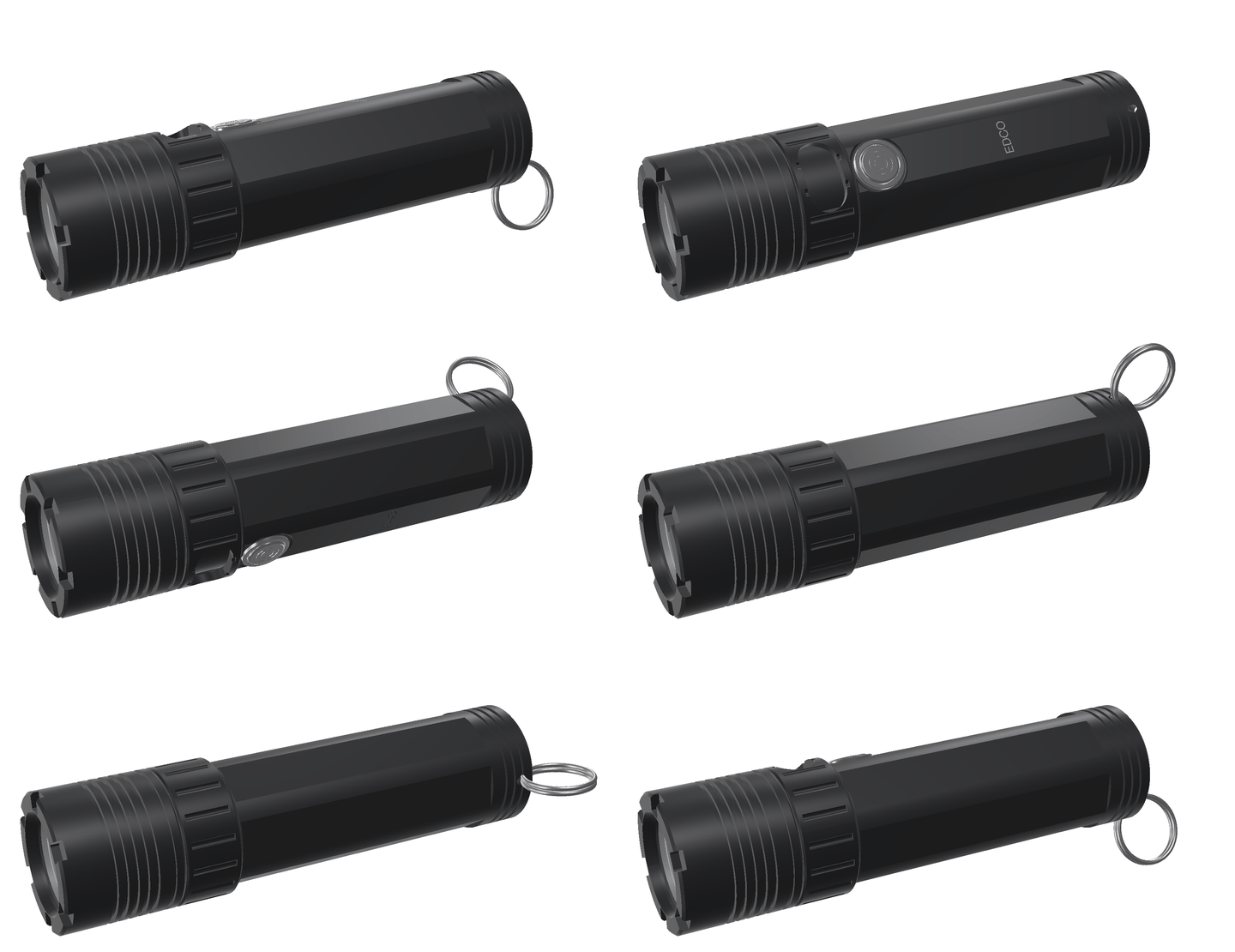
| Turning. EDCO-18 with the collar closed: crenellated bezel, flats, the button, the tail grooves. | Coming apart. Bezel, optic, LED board, head insert, collar, button parts, main board, cell, body. |
 |
 |
|---|---|
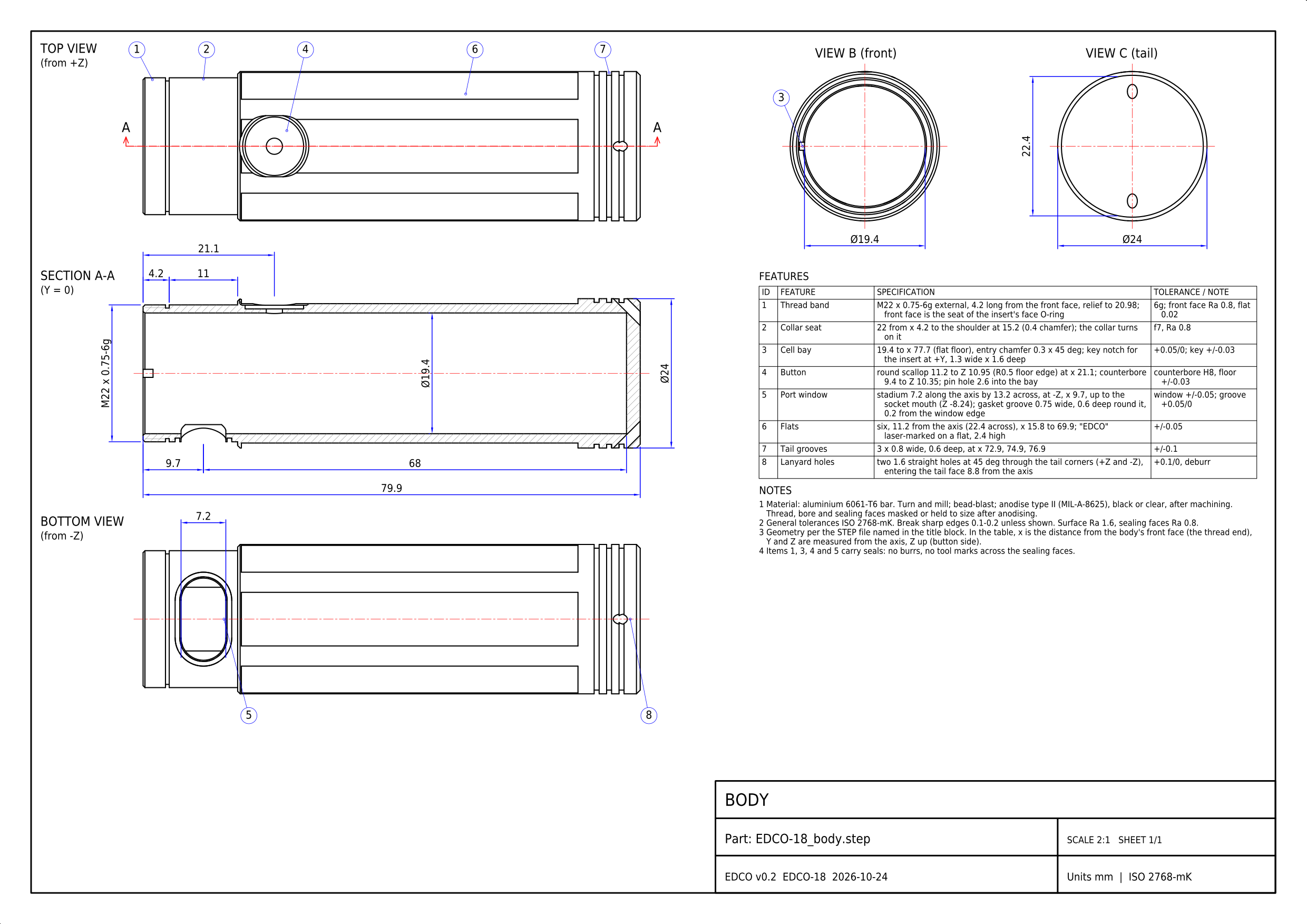
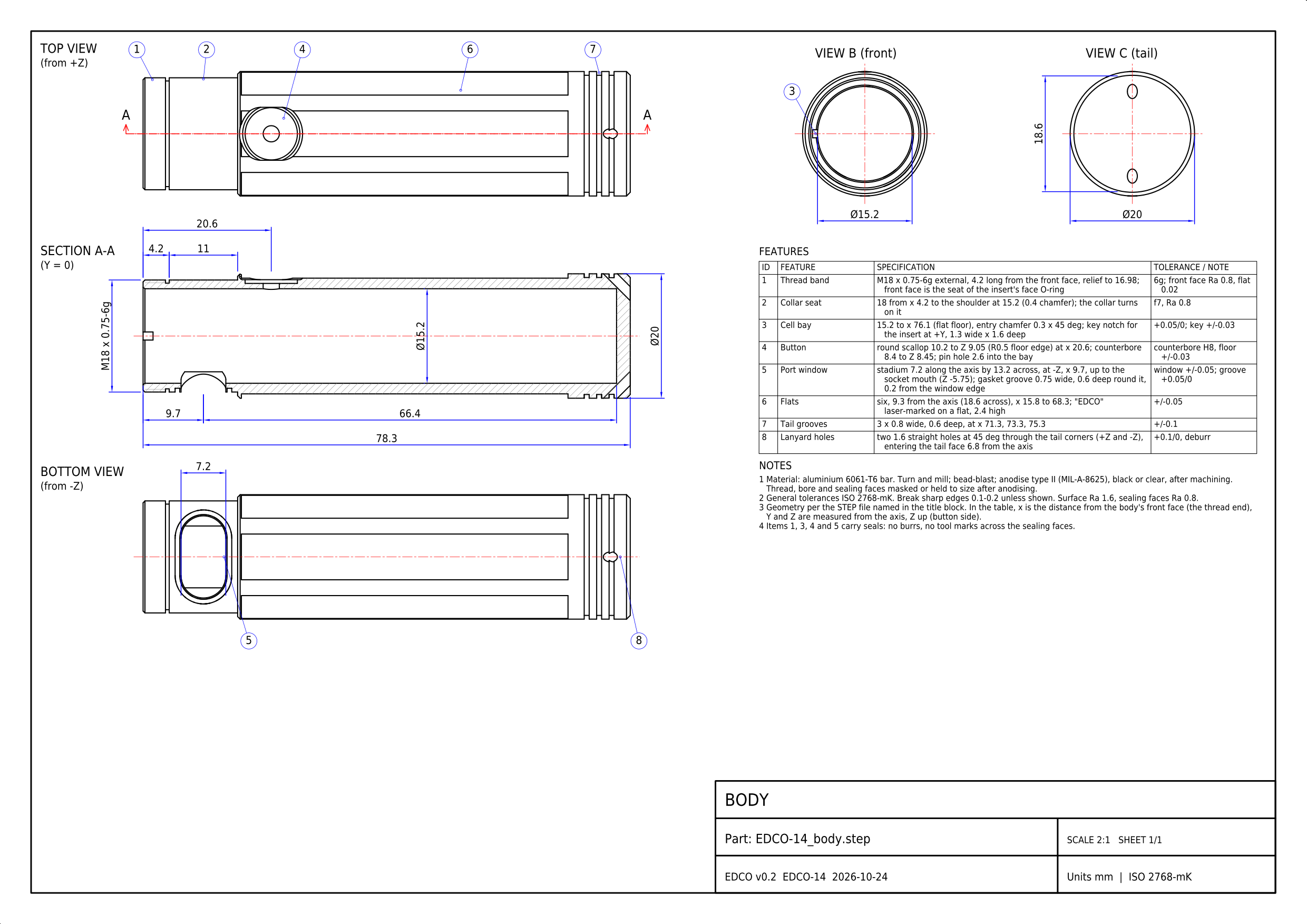
| EDCO-18 body: PDF, DXF | EDCO-14 body: PDF, DXF |
The drawings are A3 sheets at 2:1, made from the same parameters as the STEP files by hardware/tools/edco_drawings.py. Each has the outline, a section, the end views and a feature table with tolerances, and every dimension on it is checked against the solid (check report). The animations are made by hardware/tools/edco_anim.py. All of them are renders and drawings of the design: nothing has been built yet.
What has been checked
- CAD interference: no part overlaps a neighbour in either size. The checked pairs include body / head insert, bezel / insert, body / collar, bezel / collar, collar / port gasket, body / sled, sled / board, body / socket, sled / socket, body / button pin, sled / cell and bezel / optic.
- Walls, EDCO-18:
- 2.3 mm over the cell, 1.5 mm under the flats;
- 0.84 mm at the thread root;
- 1.3 mm in the band, 0.7 mm under the port gasket groove;
- 0.65 mm under the button counterbore;
- 1.2 mm in the bezel at its fins, 1.55 mm in the collar at its flutes.
- Walls, EDCO-14:
- 2.4 mm over the cell, 1.7 mm under the flats;
- 0.94 mm at the thread root;
- 1.4 mm in the band, 0.8 mm under the port gasket groove;
- 0.85 mm under the button counterbore;
- 0.8 mm in the bezel at its fins, 1.55 mm in the collar at its flutes.
- Below JLCCNC’s recommended 0.8 mm (above their 0.5 mm minimum): EDCO-18’s button counterbore wall (0.65 mm), port gasket groove (0.7 mm) and thread run-out (0.79 mm).
- Fits:
- Main board: 18.3 mm wide (EDCO-18) / 14.3 mm (EDCO-14), with 0.34 mm to the bore.
- Socket mouth: 4.6 / 5.1 mm below the collar surface, so the plug’s overmould goes through the windows.
- Thread engagement: 3.3 mm.
- Cell radial room: 0.6 / 0.45 mm.
- Light and heat: simulated, as above.
All numbers are in cad/edco_v02_interface.json, written by tools/housing/edco_v02.py.
Open points before the first order
- The collar seal is a new design. No production light documents how its rotating port cover seals. Build one collar and band first and test them under water: closed, after many turns, and with grit.
- The optic heights. The Carclo 20 mm optic’s height depends on its holder (10–13.8 mm; 11.5 mm is drawn). Check the TINA-RS cavity over the SST-40’s 3 mm dome.
- Throw. The figures above are estimates from other LEDs’ data. A smooth 20 mm reflector may throw further but needs more depth.
- Parts to confirm:
- MP2145GD availability (no LCSC number found yet);
- the exact protection MOSFET and its resistance at a 3–4 V gate;
- the socket’s footprint.
- The 18500 cell. The K15 (1,500 mAh, 15 A) is verified; a 2,000 mAh option is not. No EU shop seen with high-drain 18500 stock.
- Replacing the cell (BAT-2), as in v0.1: fine for your own light. From 18 February 2027, though, a light sold in the EU must let its user replace the cell.
- The boards, drawings, order files and a parts and cost workbook, as for v0.1.
Files
| Path | What |
|---|---|
| cad/ | for each size (EDCO-18_*, EDCO-14_*): body, bezel, head insert and collar as STEP (plain thread diameters), and the assembly STEP |
| cad/edco_v02_interface.json | sizes, walls, fits, masses and the interference check of both sizes |
| cad/EDCO-18_body_drawing.pdf, EDCO-14_body_drawing.pdf (and .dxf, .png) | the body drawings (A3, 2:1) |
| tools/housing/edco_v02.py | the CadQuery model (sizes in SIZES, common dimensions in class P): python3 edco_v02.py ../../cad --size both |
| tools/housing/edco_v02_render.py | the renders: xvfb-run -a python3 edco_v02_render.py ../../assets (uses the FlashKa v0.7 renderer) |
| ../tools/edco_drawings.py, ../tools/edco_anim.py | the drawings and the animations of all EDCO designs: python3 hardware/tools/edco_drawings.py, xvfb-run -a python3 hardware/tools/edco_anim.py (from the repository root) |
| ../../firmware/boards/edco-v02-18/, edco-v02-14/ | the firmware board headers, each with the thermal model for the simulator |
Licences as for the rest of LuxLibre: hardware CERN-OHL-W-2.0, firmware and tools GPL-3.0-or-later, this page CC-BY-SA-4.0 (LICENSING.md).